AI agents in companies: when software works for you
October 10, 2026
7 minutes
Readings
Let's admit one thing. Almost everyone uses artificial intelligence today. Some write texts with it, some create presentations, some have Excel tables generated for them. AI has become a universal assistant: you open it, ask a question, get an answer, and continue.
But while most people are using AI as a handy tool, something a level higher is starting to appear in companies. AI agent. And surprisingly, a lot of people still don't know about it at all. Which is a bit of a shame, because it's precisely the thing that can save companies hours of work daily.
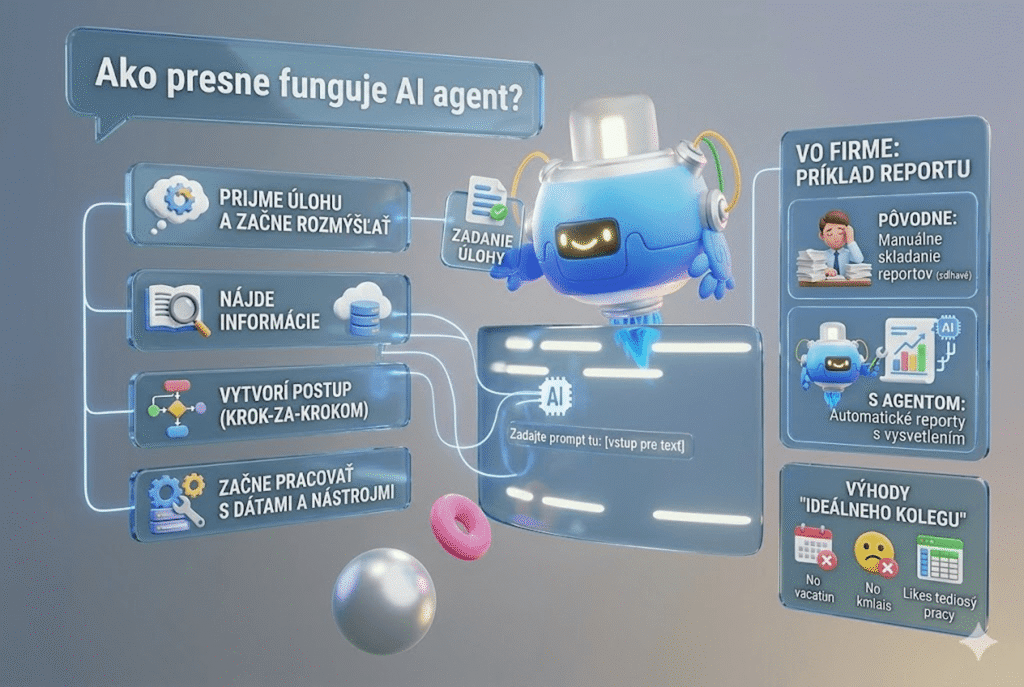
While classic AI answers questions, an AI agent He gets the task and goes to work.. It figures out what needs to be done, finds information, opens your company systems, and delivers results. In principle, it behaves like a new colleague at work, but without the entire onboarding process.
How exactly does an AI agent work?
The simplest explanation sounds like this: An AI agent is a system that can solve tasks independently..It functions as a standalone process that receives a task and begins to think about how to complete it. First, it find information, then create a procedure and then starts to work with yours tools or give me.
In a company, it might look like this: the classic for every company – reports. Someone manually compiles numbers from different systems every week. An agent does it automatically and even adds a brief explanation of what actually changed. Indeed, quite a pleasant colleague who doesn't take vacations, doesn't complain about Mondays, and enjoys working with spreadsheets and tedious tasks.
Why do companies favor AI agents?
If we look at the reality of most companies, we'll find an interesting thing. A large part of the work is not strategy, innovation, or brainstorming. A large part of the work is precisely searching for things.
Questions like: where is that document? who has the latest version? why don't the numbers add up? Where exactly is that file located? In some companies, a job position could easily exist „Senior Information Seeker“.
And right here AI agents are starting to make a lot of sense. Companies that implement them often talk about three major changes.
Speed – things that used to take hours or days are now happening in minutes.
Availability of information – the agent can search systems, documents, and databases all at once – something that would take a human half a day.
Removing the routine – people stop doing endless repetitive tasks.
According to surveys today, over half of organizations are already using AI agents for multi-step workflows, and approximately 80 %firearm He says that investing in agents brings them real economic benefit. Approximately 57 % organizations have already implemented AI agents in recent years, and most plan to expand their use further.
In other words, an AI agent is not just an IT department experiment. It is becoming a common part of operations, making the company a little faster, clearer and peacefully too less chaotic.
How to apply an AI agent?
When you talk about implementing AI in a company, many managers imagine a huge project. Workshops, meetings, roadmaps, three presentations titled„Digital Transformation 2030“somewhere in between, the IT team quietly wonders what they've gotten themselves into now.
In practice, it usually looks much simpler.
Step one is not technology. It's a simple question: What slows us down the most at the company? Not what's most trendy. Not what would look good at a conference. But what actually takes up people's time every day. If something is done often and using the same procedure, there's a high chance AI can handle it.
the AI agent is smart, but it needs one thing – information.Documents, databases, systems, internal knowledge. The good news is that most companies already have this data; it's just scattered everywhere. A simple equation: The more you compact your data, the more useful it will be for you and AI agents to work with.
Connect the agent with the tools you use in your company. If the agent can only see one document, it can't do much. However, if it can see the company systems, it can suddenly do much more.
One of the most common mistakes in AI projects is trying to solve everything at once. The reality is that the best projects start with a very small experiment. One problem. One process. One agent. With the simple goal of finding out if it works and what value it brings.
The step that determines success more than the technology itself is engagement of people. If employees realize that the agent doesn't want to replace them or complicate their work, but rather save them time by preparing documents, searching for information, or creating reports, the situation will change. From resistance comes curiosity. From curiosity comes experimentation. And from experimentation comes a new way of working.
Voilà. A new way of working is here. AI agents handle the routine, systems communicate with each other, and you can calmly go get a coffee. Or at least finally finish those things that there was never time for before.
Conclusion
An AI agent can help a company with several very practical things. It saves time on repetitive tasks, speeds up access to information, helps analyze data, and automates processes. Result: higher productivity, less chaos, and more time for important things. When it succeeds, the company suddenly runs a bit smoother. Less manual work, less stress, and more room for what drives the company forward.
The goal of AI is not to replace people. The goal is to stop slowing people down with routine tasks.
This is why AI agents are appearing in more and more companies today. And if it continues at this pace, it's quite possible that in a few years they will be completely commonplace. Much like cloud, Slack, or internal company chat are today. With one difference. These colleagues will never forget where that important document is stored.
Share post
Article content
Do you know where exactly you're wasting time and money?
Launch our NONSENSE SCANNER. In 3 minutes, you'll find out how much precious time and money you're actually burning on unnecessary operations.
We use technologies such as cookies to store and/or access device information to provide the best experience. Consenting to these technologies will allow us to process data such as browsing behavior or unique IDs on this site. Not consenting or withdrawing consent may adversely affect certain features and functions.
Functional
Always active
Technical storage or access is necessary for the legitimate purpose of enabling the use of a specific service explicitly requested by the subscriber or user, or solely for the purpose of transmitting a communication over an electronic communication network.
Preferences
The technical storage or access is necessary for the legitimate purpose of storing preferences that are not requested by the subscriber or user.
Statistics
Technical storage or access that is used exclusively for statistical purposes.A technical storage or access that is used exclusively for anonymous statistical purposes. Without a subpoena, voluntary compliance by your Internet Service Provider, or additional records from a third party, information stored or retrieved solely for this purpose can usually not be used to identify you.
Marketing
Technical storage or access is necessary to create user profiles for ad serving or user tracking on a website or across multiple websites for similar marketing purposes.